

Jordan Walker entered the 2026 season with more questions than answers. Once considered one of the most promising prospects in the St. Louis Cardinals organization, the young outfielder had struggled to establish himself as a consistent major league hitter.
After two disappointing seasons, Walker needed to prove that his offensive potential could translate into sustained production at the highest level.
Walker finished 2026 with a .269 batting average, 29 home runs, 102 RBIs and 22 stolen bases across 158 games. His .269/.327/.466 slash line represented a significant improvement over the .215/.278/.306 he produced in 2025.
For a Cardinals organization focused on developing its next competitive core, Walker’s resurgence could have important implications heading into 2027.
But the most interesting part of his breakout season goes beyond the traditional numbers.
Advanced metrics suggest that Walker’s raw power never disappeared. Instead, he became considerably more effective at turning that power into meaningful offensive production.
What FanGraphs and Statcast Reveal About Walker’s Breakout
According to FanGraphs, Walker finished 2026 with a 119 wRC+ and 2.7 fWAR, compared with a 66 wRC+ and -1.3 fWAR the previous season. His isolated power (ISO) increased from .091 to .197, while his strikeout rate declined from 31.8% to 26.1%. These improvements suggest that Walker became a more effective offensive contributor while making meaningful progress in his approach at the plate.
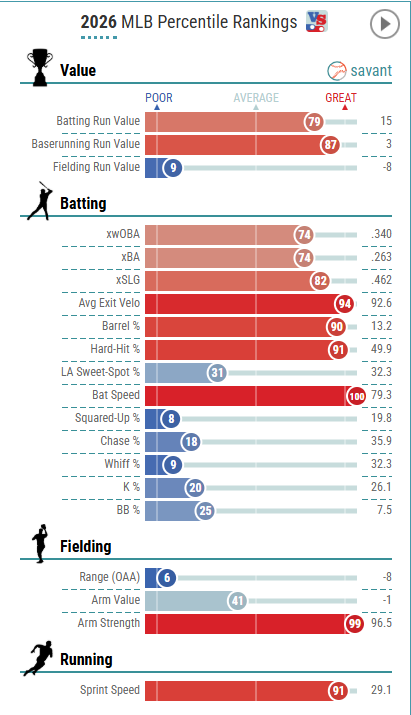
Statcast data provides further evidence of his development. Walker’s average exit velocity remained relatively stable, increasing from 92.3 mph to 92.6 mph, but his barrel rate climbed from 10.9% to 13.2%. His expected weighted on-base average (xwOBA) also improved from .278 to .340, while his expected slugging percentage (xSLG) rose from .363 to .462. Rather than simply hitting the ball harder, Walker became more effective at converting hard contact into productive results.
Another encouraging aspect of Walker’s development was his ability to generate more productive launch angles. His average launch angle increased from 10.3 to 11.8 degrees, while his sweet-spot rate improved from 29.0% to 32.3%. These adjustments helped him capitalize on his natural strength, turning more of his hard-hit balls into extra-base opportunities. For a hitter who previously struggled to translate impressive exit velocities into consistent production, that represents a meaningful step forward.
Can Walker Become a Long-Term Building Block?
Despite his offensive resurgence, Walker still has areas to improve. His 26.1% strikeout rate remains relatively high, while Statcast credited him with -8 Outs Above Average (OAA) in 2026, highlighting ongoing defensive concerns. Improving his plate discipline and outfield performance could significantly increase his overall value to St. Louis.
Early FanGraphs projections for 2027 suggest a more conservative offensive outlook, with a slash line near .256/.318/.441 and a 110 wRC+. While some regression is possible, Walker’s improvements in power production and quality of contact provide reasons for optimism. For the Cardinals, the challenge is no longer determining whether Walker has major league talent, but whether he can turn his breakout season into sustained success.
Walker has already shown that he possesses the tools to become a productive major league hitter. His next challenge is turning one successful season into sustained performance. For a Cardinals organization attempting to build its next competitive core, that development could be just as important as any major acquisition during the offseason.